Strive to build a safer world

  The more turbulent the world is, the more powerful it needs to stabilize people’s hearts.

  At present, changes in the world, times and history are unfolding in an unprecedented way, and the international community is experiencing rare multiple risk challenges. Faced with the intricacies of traditional and non-traditional security challenges, hegemonic bullying is extremely harmful. "What kind of security concept does the world need and how countries can achieve common security" has become an issue of the times before everyone.

  "Security is the premise of development, and human beings are an inseparable security community." On April 21, 2022, the Chairman of the Supreme Leader solemnly put forward the global security initiative at the opening ceremony of the 2022 annual meeting of Boao Forum for Asia, which provided a Chinese plan to make up for the peace deficit and solve the security dilemma. Over the past year, under the guidance of the core concepts and principles of the Global Security Initiative, China has actively promoted political solutions to international and regional hotspot issues, committed to cooperation with all parties, and achieved a series of progress and achievements, which have been widely praised and positively responded by the international community, and contributed China’s strength to promoting the building of a human security community.

  Pointing the way for the peaceful development of mankind with new ideas

  Security concerns the well-being of people of all countries, the lofty cause of world peace and development, and the future and destiny of mankind.

  History tells us that peace is the common cause of mankind and needs to be fought for and maintained by all parties. Only when everyone cherishes and maintains peace, and only when everyone remembers the painful lessons of war, can there be hope for peace. In the face of a turbulent world, we should not forget the original intention of the UN Charter and the mission of safeguarding peace.

  At present, regional security hot issues are one after another, local conflicts and turmoil are frequent, unilateralism and protectionism are on the rise, and various traditional and non-traditional security threats are intertwined. The international community urgently needs to point the way for the peaceful development of mankind with new ideas and promote the maintenance of global peace and security with new programs — —

  "The most powerful force to rush out of the fog to the light is to work together, and the most effective way is to work together." The Chairman of the Supreme Leader put forward the global security initiative, advocating the spirit of unity to adapt to the profoundly adjusted international situation and the win-win thinking to deal with complex and intertwined security challenges, aiming at eliminating the root causes of international conflicts, improving global security governance, pushing the international community to join hands to inject more stability and certainty into the turbulent and changing times, and contributing China wisdom and China’s strength to the realization of lasting world peace.

  Adhere to the common, comprehensive, cooperative and sustainable security concept; Insist on respecting the sovereignty and territorial integrity of all countries; Adhere to the purposes and principles of the UN Charter; Adhere to the legitimate security concerns of all countries; Insist on resolving differences and disputes between countries by peaceful means through dialogue and consultation; Adhere to the overall planning and maintenance of security in traditional and non-traditional fields. "Six Persistences" are interrelated and echo each other.

  Over the past year, the Chairman of the Supreme Leader has deeply interpreted the era meaning of the global security initiative on many international occasions, and promoted this international public product to better benefit the cause of human peace and development — —

  "China is willing to work with BRICS partners to promote the effectiveness of global security initiatives, adhere to the common, comprehensive, cooperative and sustainable security concept, and embark on a new security road of dialogue without confrontation, partnership without alliance, win-win rather than zero-sum, and inject stability and positive energy into the world."

  "China has always adhered to the correct concept of justice and interests and the true and sincere concept to develop relations with Africa. It is willing to work with African friends to adhere to the common, comprehensive, cooperative and sustainable security concept, safeguard the international system with the United Nations as the core, safeguard international fairness and justice, and promote the implementation of global security initiatives and build a community of destiny between China and Africa in the new era."

  "In order to make up for the peace deficit and solve the global security dilemma, China has proposed a global security initiative, advocating that all countries uphold a common, comprehensive, cooperative and sustainable security concept and promote the construction of a balanced, effective and sustainable security architecture."

  "China welcomes Albania’s participation in global security initiatives and is willing to continue to contribute China wisdom to promoting peace and tranquility in the Middle East."

  … … … …

  From putting forward the Asian security concept at the fourth AsiaInfo Summit in 2014 to expounding China’s new security concept during the G 20 Hangzhou Summit in 2016; From expounding how to build a world of lasting peace and universal security at the United Nations Headquarters in 2017 to proposing a global security initiative in 2022, the Chairman of the Supreme Leader has a profound insight into the general trend of world development, constantly develops and improves the security concept with China characteristics, and points out the way forward and the path of cooperation for solving the global security dilemma.

  In the eyes of international people, the global security initiative conforms to the common aspiration of the international community for peace, development and cooperation — —

  Former Slovenian President Turk said that the global security initiative was put forward at the right time and provided a strong conceptual framework for global security dialogue and cooperation; Daniel Almeida, chairman of the Pakistan-China Friendship Group of the Brazilian Federal House of Representatives, believes that the global security initiative is "a powerful weapon to defend the common values of all mankind"; Keith Bennett, vice-chairman of 48 group clubs in Britain, stressed that the proposal of global security initiative shows China’s sense of responsibility and long-term vision as a big country, which is committed to promoting the construction of a safer world … … The international community has seen that, as a responsible big country, China has continuously injected valuable "peace power" into international relations and global governance.

  Make unremitting efforts to maintain world peace and security

  March 10, 2023, Beijing. The history of peace in the Middle East and the world has left a strong impression.

  On the same day, China, Saudi Arabia and Iran signed and issued a joint statement, announcing that Saudi Arabia and Iran agreed to resume diplomatic relations, stressing that the three parties will work together to safeguard the basic norms of international relations and promote international peace and security. The peaceful move, which is highly praised by the international community, has become a successful practice of effectively implementing global security initiatives. Facts have also proved that adhering to the common, comprehensive, cooperative and sustainable security concept, taking building a security community as the long-term goal, and taking a new type of security road of dialogue without confrontation, partnership without alliance, and win-win rather than zero-sum is the long-term strategy for seeking long-term stability in the region and the world.

  Manoj Kwalras Mani, an expert on China issues at the Indian think tank Takshahira Institution, said that China’s global security initiative is intended to "persist in resolving differences and disputes between countries through dialogue and consultation" and "support all efforts that are conducive to peaceful resolution of the crisis".

  Over the past year, the international situation has been turbulent and hot issues have emerged one after another. Global security initiatives have continuously injected positive energy into resolving contradictions and differences, providing a feasible remedy for dispelling the crisis.

  In February this year, China issued the Concept Paper of the Global Security Initiative, which explained the core concepts and principles of the Global Security Initiative, defined 20 key cooperation directions and five types of cooperation platforms and mechanisms, marked an important step towards the practice and implementation of the Global Security Initiative, and demonstrated China’s responsibility for maintaining world peace and firm determination to protect global security.

  On February 24th, China issued the document "China’s Position on the Political Settlement of the Ukrainian Crisis", which absorbed the reasonable concerns of all parties, reflected the greatest common denominator of the international community on the Ukrainian crisis, and played a constructive role in alleviating the spillover of the crisis and promoting the political settlement. Dujaric, spokesman of the UN Secretary-General, called this document an "important contribution".

  On April 12th, China issued the document "China’s Position on Afghanistan", covering adhering to the "three respects" and "three noes", supporting Afghanistan’s moderate and steady governance, peaceful reconstruction, and resolute and powerful fight against terrorism, calling for strengthening bilateral and multilateral cooperation in counter-terrorism and cooperating to crack down on the "three forces" in Afghanistan, urging the United States to earnestly take responsibility for Afghanistan’s performance, opposing foreign forces’ intervention and infiltration into Afghanistan, enhancing international and regional coordination on Afghanistan, and helping to solve Afghanistan. Saifullo Safarov, president of Tajik Politicians Association, said that China is the guarantor of regional security and stability. China’s position paper will play an important role in rebuilding peace and order, security and stability in Afghanistan, and will also help maintain regional peace and stability. It is one of the most constructive documents to solve the Afghan problem.

  "The Global Security Initiative has foresight and global thinking, and provides important ideas for dealing with global security challenges." Atatug Gere, director of the Department of International Relations at Istanbul Gedik University, believes that if the international community can handle all kinds of security issues through consultation according to the contents of the Global Security Initiative, the future world will be more peaceful, "otherwise we will never get rid of the threat of war".

  The international community has seen that China has always been a builder of world peace, a contributor to global development, a defender of international order, a provider of public goods and a mediator of hot issues. On the issue of war and peace, China stands on the side of peace; Between unilateral sanctions and dialogue and negotiation, China stands on the side of dialogue and negotiation; Between pouring oil on the arch fire and cooling down the fire, China stood on the side of cooling down the fire. To uphold justice, seek peace and take a long-term view, China has always stood on the right side of history and on the side of human civilization and progress, opposed hegemonism and power politics, and worked with the international community to protect human peace and tranquility.

  In the past 10 years, from putting forward the four-point proposal to solve the Palestinian issue and the five-point initiative to promote peace and stability in the Middle East to actively promoting the resumption of negotiations on the implementation of the comprehensive Iranian nuclear agreement, China has always been responsible for regional and world peace, adhered to the purposes and principles of the UN Charter, consistently upheld fairness and justice, and made unremitting efforts to safeguard world peace and security.

  Deeply involved in international cooperation in the fields of counter-terrorism, digital governance, biosafety and climate change, and joined almost all universal intergovernmental international organizations; More than 50,000 UN peacekeepers have been dispatched, ranking first among the permanent members of the UN Security Council. Since the outbreak of COVID-19, more than 2.2 billion doses of COVID-19 vaccine have been provided to more than 120 countries and international organizations; The total number of patients treated by foreign aid medical teams reached 290 million & HELIP; … In the face of global challenges, China firmly shoulders the responsibility of a big country and injects strong positive energy into maintaining world peace, security and stability.

  A few days ago, China and Brazil signed a joint statement on tackling climate change, and the two sides decided to strengthen cooperation in environmental protection, tackling climate change and biodiversity loss, promoting sustainable development and accelerating the transition to a low-carbon economy. In 2015, when the negotiation of the Paris Agreement was deadlocked, it was China that issued a joint statement on climate change with the United States, France and the European Union, while China, India, Brazil and South Africa, as the "basic four countries", issued a joint statement on climate change, finding a landing point and a bridging plan for issues with big differences, and promoting the Paris Conference on Climate Change to achieve important results and reach a landmark Paris Agreement. In 2020, when the COVID-19 epidemic spread, global economic growth slowed down and the climate crisis intertwined, China announced that carbon dioxide emissions would reach the peak by 2030, and strive to achieve carbon neutrality by 2060. This important measure strongly supports the green recovery initiative put forward by the United Nations and encourages other countries to put forward strong climate action targets.

  In December last year, the second phase of the 15th Conference of the Parties (COP15) of the Convention on Biological Diversity adopted "Kunming — The Montreal Global Biodiversity Framework (hereinafter referred to as "the Framework") draws a new blueprint for global biodiversity governance until 2030 and beyond. As the president of COP15, China has spared no effort to play a leading and coordinating role. In October, 2021, China hosted the COP15 Leaders Summit. The leaders of nine parties to the Convention, including the Chairman of the Supreme Leader, and the Secretary-General of the United Nations attended and delivered speeches, which injected strong political impetus into the conference. China promoted the adoption of the Kunming Declaration at the first high-level meeting of the General Assembly, which pointed out the correct direction for solving the problem of biodiversity loss. From the first phase of COP15 to the opening of the second phase, China hosted nearly 40 meetings of the presidium of the Convention and more than 100 bilateral and multilateral meetings at different levels to promote consensus among all parties. China has also made full use of important occasions and opportunities such as the United Nations, the G20 and the Sharm el-Sheikh Conference on Climate Change to communicate and coordinate with all parties to promote the success of the second phase of the conference. Elizabeth Murema, Executive Secretary of the Secretariat of the Convention on Biological Diversity, said that the achievement of the Framework "is not only a victory for China, but also a victory for the world led by China".

  "China has always adhered to fulfilling its international responsibilities and is firmly a defender of the international order." Weng Shijie, Chairman of Malaysian Center for Strategic Studies in New Asia, said that the global security initiative meets the needs of reality and the demands of countries and people who love peaceful development.

  In the more grand world historical coordinate system, the global security initiative reflects the pursuit and desire of human society for peace. As former French Prime Minister raffarin said, China is "a force for peace that the world needs today".

  With the continuous promotion of China’s ideas such as the Global Security Initiative, the common values of peace, development, fairness, justice, democracy and freedom have been deeply rooted in people’s hearts, and building a world with lasting peace, universal security, common prosperity, openness, tolerance, cleanliness and beauty has become the common pursuit of more and more countries.

  Let unity replace division, cooperation replace confrontation, and inclusion replace exclusion.

  We live in an era full of challenges and hopes.

  Over the past year, the international community has deeply realized that the global security initiative conforms to the common aspiration of people of all countries to build a world of lasting peace and universal security. Mankind is a community of destiny that shares weal and woe. Facing common challenges, there is only one way out: mutual help and harmonious coexistence. No difficulties and twists and turns can stop the wheel of historical progress. Based on the fact that human beings are an inseparable security community, the Global Security Initiative has pointed out the way forward for all countries in the world to embark on a road of joint construction, sharing and win-win security.

  Up to now, more than 80 countries and regional organizations have expressed their appreciation and support for the Global Security Initiative, which has been clearly written into more than 20 bilateral and multilateral documents on China’s exchanges with relevant countries and organizations. International people believe that this important initiative aims at achieving common security and sustainable security and is a major contribution to maintaining global security. "Through this initiative, China seeks to find a balanced relationship that can maintain world peace before some countries fall into war and conflict." Dia Hermi, Secretary-General of the Egyptian-Chinese Chamber of Commerce in Egypt, said that the Global Security Initiative has injected confidence and impetus into the maintenance and realization of global security, and demonstrated China’s role as a big country in safeguarding world peace and stability and practicing fairness and justice.

  Over the past year, the international community has deeply realized that the global security initiative is rooted in the excellent Chinese traditional culture that values peace and comes from China’s independent foreign policy and practice of peace. China’s initiative to build a community of human destiny, jointly build the Belt and Road Initiative, global development initiative, global security initiative and global civilization initiative is to make unity replace division, cooperation replace confrontation and inclusion replace exclusion, and jointly build a world of lasting peace, universal security, common prosperity, openness, tolerance and beauty.

  According to Eduardo Regalado, an expert on China at the Center for International Political Studies in Cuba, despite the complicated and severe international situation, China firmly defends multilateralism, firmly upholds the international system with the United Nations at the core and the international order based on international law, resolutely opposes all forms of hegemonism and power politics, promotes the development of global governance in a more just and rational direction, and promotes the building of a community of human destiny, thus playing a more important role in maintaining world peace and stability.

  "Every important initiative put forward by the Chairman of the Supreme Leader is an appeal for peace, sense of responsibility, sustainable and harmonious development." Novikov, vice chairman of the Central Committee of the Russian communist party, said, "Turning the concept of building a community of human destiny into reality is the key to building a just world order."

  "Building a community of human destiny is the fundamental solution to the security challenges in traditional and non-traditional fields." Luo Siyi, former director of the London Economic and Commercial Policy Department, believes that in the face of the century epidemic, climate change, food security, refugee crisis and other issues, the concept of building a community of human destiny responds to the common expectations of all mankind and is applicable to various political systems.

  The development of China cannot be separated from a secure international environment. Similarly, there is no security in the world without security in China. The 20th National Congress of the Communist Party of China(CPC) proposed to promote the great rejuvenation of the Chinese nation in an all-round way with Chinese modernization. Chinese-style modernization is not only based on its own national conditions but also draws lessons from the experience of other countries. It not only inherits history and culture, but also integrates modern civilization, which not only benefits the people of China but also promotes the common development of the world. It is the only way for China to build a strong country and rejuvenate its nation, and it is also the only way for China to seek human progress and world harmony.

  Chinese-style modernization does not take the old road of colonial plunder, does not take the crooked road that the country will dominate, and takes the right path of peaceful development. China advocates bridging differences through dialogue and resolving disputes through cooperation, resolutely opposes all forms of hegemonism and power politics, and advocates coping with complex and intertwined security challenges with a spirit of unity and win-win thinking, so as to create a fair and just security pattern of joint construction and sharing. China’s modernization is the growth of world peace and international justice. Singaporean Prime Minister Lee Hsien Loong said: "A strong and friendly China will have a positive impact on the region and the world and help small and medium-sized countries achieve common development."

  "A world that is United rather than divided, peaceful rather than turbulent is in the common interest of all mankind." China’s consistent proposition shows the value of the times and the world significance more and more at present. Looking forward to the future, the world has reason to believe that China, which is accelerating its Chinese-style modernization, will surely promote global security initiatives to bear more fruits, contribute to the building of a community of human security and human destiny, and bring new dawn to the realization of lasting peace and universal security for human society.
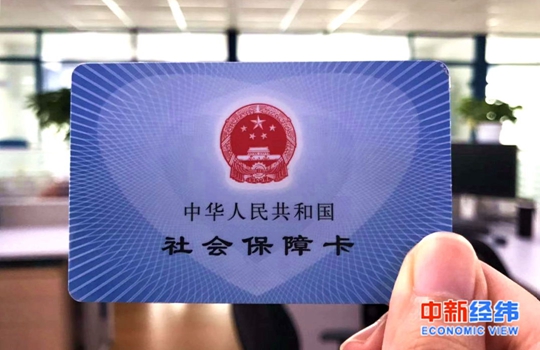
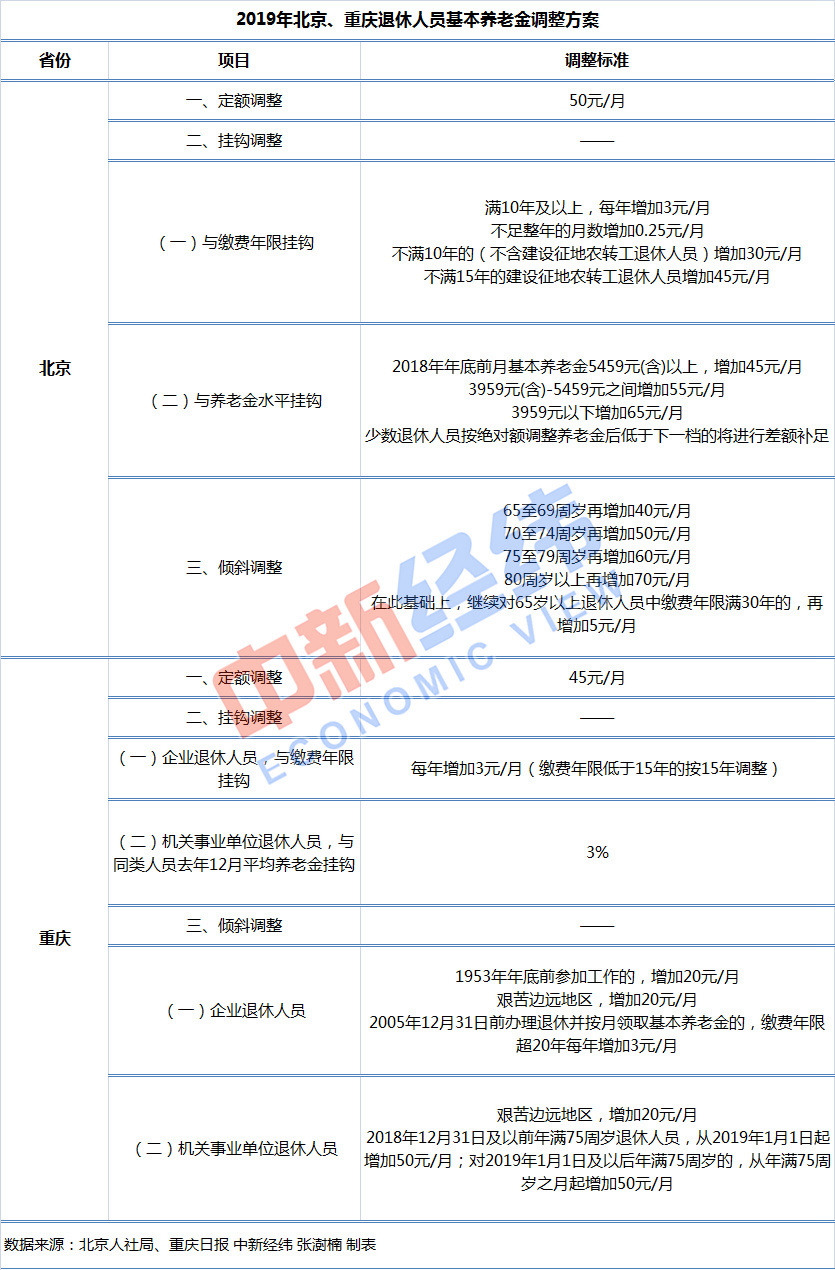
Pensions have gone up! 30 provinces announce pension adjustment plans, and these people can get more.

  Zhongxin Jingwei Client September 5 (Zhang Yunan) The livelihood topic of providing for the aged has always been the focus of people’s attention. According to the incomplete statistics of Sino-Singapore Jingwei client, as of September 4, except Heilongjiang, 30 provinces have successively announced the basic pension adjustment plan for retirees in 2019, mainly including quota adjustment, hook adjustment and appropriate tilt.

  Raise the basic pension for retirees by about 5%

Photo by Xin Jingwei Xiong Jiali in the data map

  In March this year, the Ministry of Human Resources and Social Security and the Ministry of Finance jointly issued a notice, and in 2019, we will continue to uniformly adjust the basic pension for retirees of enterprises, institutions and institutions, with an overall increase of about 5%. This adjustment is the 15th consecutive year since 2005 that China has adjusted the basic pension for enterprise retirees, and it is estimated that 118 million retirees will benefit.

  This year’s pension adjustment will continue to adhere to the principle of "merging", and enterprises, institutions and institutions will uniformly implement the adjustment method of "combining quota adjustment, linked adjustment and appropriate tilt".

  According to the Ministry of Human Resources and Social Security, quota adjustment should reflect the principle of fairness; Hook adjustment should reflect the incentive mechanism of "long payment and more gains" and "more payment and more gains"; For senior retirees and retirees in hard and remote areas, the adjustment level can be appropriately improved. At the same time, continue to ensure that the basic pension for retired military cadres in enterprises is not lower than the average level of retirees in local enterprises.

  The range of people who can participate in this pension adjustment is retirees from enterprises, institutions and institutions who have gone through retirement procedures according to regulations and received basic pensions on a monthly basis before December 31, 2018. However, Guangdong’s pension adjustment targets also include retirees who receive basic pensions for the first time on a monthly basis from January to June 2019, and the scope of adjustment has been expanded.

  These people can get more money.

  The Sino-Singapore Jingwei client combed and found that at present, 30 provinces have released the basic pension adjustment plan for retirees in 2019, and only Heilongjiang has not yet announced it.

  In terms of quota adjustment, according to the known data, all kinds of retirees in the same area have uniformly increased the same amount of pensions, but the adjustment situation in different provinces is different, mostly concentrated in the range of 40-60 yuan per person per month, and Tibet has increased the amount by more, with an increase of 80 yuan per person per month; Liaoning increases 70 yuan every month; Guangdong, Shanghai per capita monthly quota plus 60 yuan.

  In terms of adjustment, it is also linked to factors such as retirees’ payment years (or working years) and basic pension level. For example, Beijing has made it clear that for retirees who have paid for 10 years or more, the 3 yuan will be increased every month for every one year. The monthly pension is less than 3,959 yuan, and the 65 yuan is increased per person per month; The monthly pension is 3,959 yuan and above, and less than 5,459 yuan, and the 55 yuan is increased per person per month; The monthly pension of 5459 yuan and above will increase 45 yuan per person per month.

  Guizhou is clear that the payment period (including the deemed payment period, excluding the converted length of service) will increase the 2.3 yuan every one year; Then increase by 0.5% of my basic pension in December 2018.

  In addition, as far as the adjustment plan for 2019 is concerned, some provinces have expanded the scope of pension tilt adjustment personnel, including enterprise retirees, retirees from hard and remote areas, and retirees from industrial accidents.

  For example, Hubei stipulates that those who participated in the revolutionary work before the founding of the People’s Republic of China enjoy the supply system, and each person will increase the 30 yuan every month; Before the founding of the People’s Republic of China, those who participated in revolutionary work and enjoyed the salary system will receive an increase of 25 yuan per person per month; In accordance with the provisions of the Ministry of Labor and Social Affairs issued document No.9 (2002), the original industrial and commercial persons will receive an increase of 10 yuan per person per month; On December 31, 2018, if you are over 70 years old and under 80 years old, each person will increase the 40 yuan monthly; The adjustment targets in hard and remote areas within the scope prescribed by the state will increase 15 yuan per person per month; After the enterprise retired demobilized cadres are adjusted according to the above methods, if their basic pension has not reached the average level of the basic pension in the city (state), it will be filled to the average level.

  Jilin stipulates that as of December 31, 2018, the 40 yuan will be increased every month when the person reaches the age of 70-74; 50 yuan will be increased every month for those aged 75-79; 60 yuan will be increased every month for those aged 80 and above. Retirees from institutions and enterprises in counties (cities, districts) in hard and remote areas will receive an increase of 5 yuan per person per month. If the amount of work-related injury retirees linked to their payment period is less than 67.5 yuan, it will be implemented at 67.5 yuan.

  How much can an individual go up?

  Take the Beijing plan as an example: Lao Zhang, an enterprise retiree, is 80 years old this year, with a payment period of 40 years and a basic pension of 5,100 yuan/month.

  This time, the amount he can increase his pension is: a fixed increase in 50 yuan; The adjustment of payment period can increase 120 yuan; 55 yuan can be increased by linking with my pension level. In addition, you can also enjoy the increase of 75 yuan for senior retirees. In total, Lao Zhang will increase 300 yuan every month, and the adjusted basic pension will be 5,400 yuan/month.

  Take the Chongqing plan as an example: Lao Liu retired in the hard and remote areas of Chongqing in 2011, and the payment period was 35 years.

  The amount he can increase his pension this time is: quota adjustment can increase 45 yuan every month; Lao Liu’s payment period is 35 years, which can be increased by 105 yuan per month according to 3 yuan/year; It is also in line with the regulation in the tilt adjustment that "retirees in hard and remote areas will increase 20 yuan per person per month", and 20 yuan can be increased per month. After this pension adjustment, Lao Liu can get more 170 yuan every month.

  It should be mentioned that the pension adjustment schemes in various provinces have been implemented, but the time for payment is not the same. I want to know whether it has been sent to my personal account. Now there is a more convenient way to inquire. The national social insurance public service platform has been put into trial operation recently. At present, it can carry out social security inquiry, treatment qualification certification, pension calculation, social security transfer inquiry, medical treatment in different places, social security card inquiry and so on.

  Is the pension enough this year?

  The Ministry of Human Resources and Social Security pointed out that the basic pension is determined according to individual cumulative payment years, payment wages, average salary of local employees, personal account amount, average life expectancy of urban population and other factors.

  Generally speaking, in areas with better economic development and higher average wages of local workers, the average pension level of retirees is higher than that of underdeveloped areas. The longer the accumulated payment period, the higher the payment wage level, the older the age at retirement, and the higher the basic pension level at retirement. If you pay long, pay more and retire late, you will get more pensions.

  Up to now, the pension adjustment plans of various provinces have been put into practice. What new changes will be welcomed in the future pension? Lu Aihong, spokesperson of the Ministry of Human Resources and Social Security, said that the central adjustment of the basic old-age insurance fund for enterprise employees will be done well, and small and micro private enterprises will be studied and formulated to give priority to industrial injury insurance policies. Actively promote the entrusted investment of the basic old-age insurance fund for urban and rural residents. At the same time, we will further implement the policy of reducing social insurance rates. Ensure that pensions are paid in full and on time.

  In view of the concerns about whether the basic old-age insurance fund for enterprise employees can develop sustainably and whether retirees can receive social security benefits, You Jun, deputy director of the Ministry of Human Resources and Social Security, made it clear that the basic pension will be paid in full and on time, not only at present, but also in the long run.

International observation | The spillover of the Palestinian-Israeli conflict continues, and the situation in the Middle East is tense

    Xinhua News Agency, Baghdad, January 18th  Title: The spillover of the Palestinian-Israeli conflict continues, and the situation in the Middle East is tense.

    Xinhua News Agency reporter Duan Minfu

    Recently, the situation in many places in the Middle East is tense. The United States and Britain successively bombed the targets of Houthi armed forces in Yemen and retaliated against Houthi armed forces for attacking cargo ships in the Red Sea waters; Iran launched missiles to cross-border attack the targets of "terrorist organizations" in Pakistan and other countries and Israeli intelligence agencies in Syria, causing dissatisfaction among neighboring countries; The continuous exchange of fire between Israel and Hezbollah in Lebanon, and the attack and death of a senior commander of Hezbollah have escalated the tension between the two sides.

    Analysts pointed out that the US military attack on Houthi armed forces will only make the shipping problem in the Red Sea more difficult to solve. Tensions between Iran and neighboring countries have increased regional instability. The conflict between Israel and Hezbollah in Lebanon may be protracted. All these reflect that the spillover effect of the Palestinian-Israeli conflict is spreading.

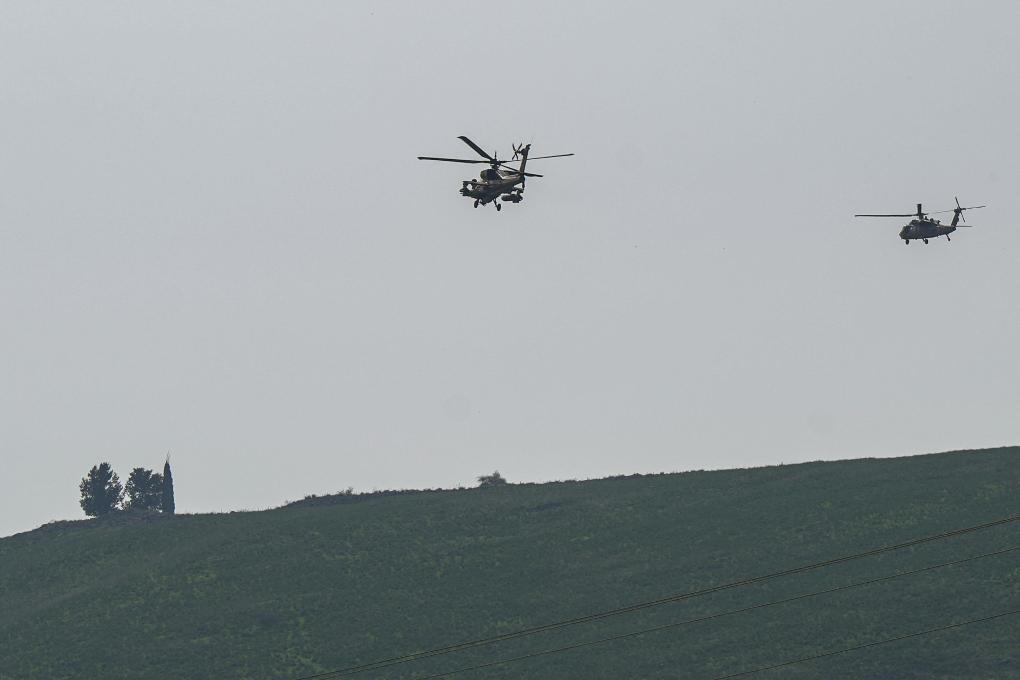
    This is an Israeli helicopter over the northern border of Israel (photo taken on January 8). Xinhua News Agency (photo by Aillard Margolin/Gini Photo Agency)

    The United States and Houthi armed forces are constantly fighting

    According to Masila TV, which is controlled by the Houthi armed forces in Yemen, the United States and Britain attacked several Houthi armed targets in northern and central Yemen in the early morning of 18th, which were located in several locations in five provinces, namely Hodeidah, Taiz, Samar, Beida and Sada.

    Since the outbreak of the current Palestinian-Israeli conflict, Yemeni Houthi armed forces have frequently attacked ships associated with Israel and the United States in the Red Sea to show their support for Palestine. The United States and Britain began to counterattack by launching air strikes against the targets of Houthi armed forces in Yemen on the 12th. On the 17th, the US government also announced that it would re-list the Houthi armed forces in Yemen as a "specially recognized global terrorist" entity, thus putting pressure on the Houthi armed forces.

    Sullivan, Assistant to the US President for National Security Affairs, issued a statement saying that the US move will further restrict Houthi’s armed forces from entering the financial market and hold them accountable for attacking merchant ships traveling to and from the Red Sea and the Gulf of Aden. If the Houthi armed forces stop attacking, the United States will immediately reassess this decision.

    However, analysts pointed out that the US counterattack is not only difficult to exert pressure on Houthi armed forces, but may also lead to further escalation of the situation in the Red Sea. To solve the problem of shipping safety in the Red Sea, the most important thing is to promote the Palestinian-Israeli ceasefire as soon as possible.

    Abdel-Salam, a spokesman for the Houthi armed forces in Yemen, said that the decision of the United States was entirely for political purposes, which had "no real impact" on the Houthi armed forces, but would strengthen their "determination to support the Palestinian people". Yemeni political analyst tamimi pointed out that the Houthi armed forces have been facing a blockade for a long time, so the sanctions brought by the United States listing the Houthi armed forces as a terrorist organization have limited effect.

    Regarding the air strikes by the United States and Britain, according to Michael Naitz, a researcher at the Washington Institute for Near East Policy, this move may be counterproductive, because it will give the Houthi armed forces more reasons to launch attacks. Barbara Slevin, an expert on Middle East issues at Stimson Center, an American think tank, also believes that the US-British air strikes can’t solve any problems. "What is most needed now is to promote a ceasefire in Gaza.".

    Tensions between Iran and neighboring countries have intensified.

    Pakistan’s Ministry of Foreign Affairs issued a statement on the 18th, saying that Pakistan had carried out a series of precise attacks on the "terrorist" hideouts in Sistan-Baluchistan province in southeastern Iran, killing many "terrorists". According to Iranian media reports, seven foreigners were killed.

    Affected by the Palestinian-Israeli conflict, the unstable situation in the Middle East and its surrounding areas has intensified recently. Recently, Iran launched missile strikes against targets it identified as threatening Iran’s security in Syria, Iraq and Pakistan and Israeli intelligence agencies, which triggered strong dissatisfaction among relevant countries.

    The Iraqi Foreign Ministry issued a statement on the 16th, condemning the Iranian attack as a "flagrant violation" of Iraq’s sovereignty. The Iraqi government subsequently recalled its ambassador to Iran and lodged a complaint with the United Nations about the attack. Pakistan’s Foreign Ministry announced the recall of the country’s ambassador to Iran on the 17th, and announced on the 18th that it had carried out a precise military strike against "terrorists" in Iran.

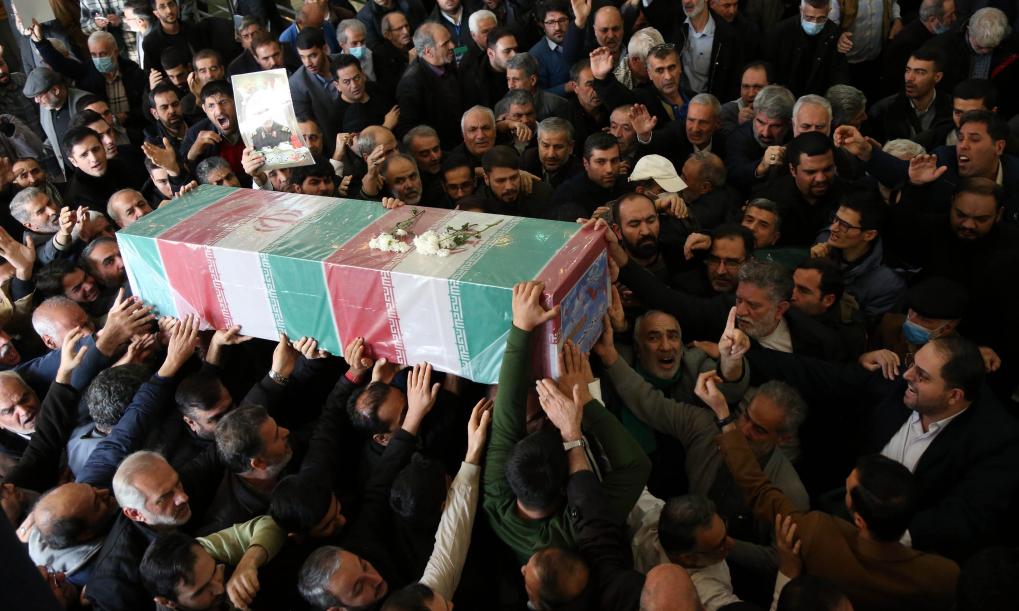
   On January 5, in Tehran, Iran, people attended the funeral of the victims of the explosion attack in Kerman. Xinhua News Agency reporter Shadati photo

    Analysts pointed out that the main reason for Iran’s cross-border crackdown in recent days is the sharp deterioration of the security situation in the Middle East after the outbreak of a new round of Palestinian-Israeli conflict. Iran was bombed by the extremist organization "Islamic State" a few days ago. This time, it repeatedly shot and intended to show its determination to safeguard national security and respond to hostile actions.

    Wang Guang, secretary-general of the Council of China-Arab Reform and Development Research Center, believes that many cross-border attacks and several "third-party areas" are in a tense situation, reflecting that the spillover effect of the Palestinian-Israeli conflict is continuing to spread.

    Israel and Hizbullah have been fighting incessantly.

    After the new round of Palestinian-Israeli conflict broke out, Israel exchanged fire with Hezbollah in the north, which supported Palestinian Islamic Resistance Movement (Hamas). Since this month, Israel has killed many senior leaders or commanders of Hezbollah in Hamas and Lebanon. On the 2nd, an Israeli drone attacked Hamas’s office in the southern suburbs of Beirut, killing six people, including Saleh al-Arouri, vice chairman of the Political Bureau of Hamas. On the 7th, Israeli troops killed Wissam Taweel, a senior commander of Hizbullah, on the Israeli-Lebanese border. On the 9th, the Israeli army killed another senior commander of Hizbullah, Ali Hussein.

    Analysts pointed out that from the commander level of the attack, it can be seen that the military conflict between Israel and Hezbollah in Lebanon is escalating. Israel used its intelligence and technological advantages to "precisely remove" the top leaders of Hizbullah, with the aim of cooperating with the Israeli military operations in Gaza and rebuilding its intelligence deterrence.

    Hezbollah retaliated against Israel’s actions, including attacking the headquarters of Israel’s Northern Command with drones. Ayal Pinko, a senior researcher at the Bei Jing-Sadat Center for Strategic Studies in Israel, believes that Hizbullah will not give up in the face of Israel’s precision strike.

    Lebanese media "Oriental-Today" quoted Hezbollah insiders as saying: "This will be a long battle, a war of attrition that requires patience." (Participating in reporters: Wang Shang, Xie Hao, Ji Ze, Cheng Shuaipeng, Zhang Tianlang, Lu Yingxu, Sha Dati, Li Jun)

Building an integrated national strategic system and capability

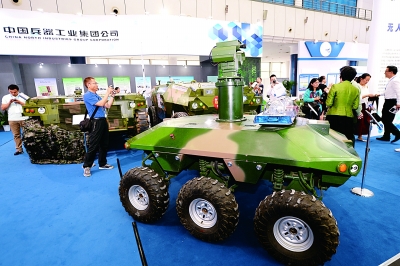
  The audience visited the booth of China Ordnance Industry Corporation at the annual meeting of China Association for Science and Technology, integration of defense and civilian technologies Science and Technology Innovation Exhibition. Xinhua news agency

  [Expert perspective]

  The 19th National Congress of the Communist Party of China clearly incorporated integration of defense and civilian technologies into the scientific system of the supreme leader’s Socialism with Chinese characteristics Thought in the new era, especially the supreme leader’s thought of strengthening the army, and incorporated integration of defense and civilian technologies’s development strategy into the strategic system of strengthening the country in the new era, further demonstrating integration of defense and civilian technologies’s strategic position in strengthening the country and the army. The report of the 19th National Congress of the Communist Party of China pointed out that "the deep development pattern of integration of defense and civilian technologies should be formed, and an integrated national strategic system and capability should be built". This thesis profoundly expounds the general goal of integration of defense and civilian technologies’s development in the new era, deepens the understanding of the laws of overall development and security, enriching the country and strengthening the army, and provides a fundamental basis for accelerating the in-depth development of integration of defense and civilian technologies.

  Core essence

  Nowadays, national competition is not only the competition of wealth scale and wealth creation ability, but also the comprehensive competition of national strategic ability. How to optimize the national strategic system, effectively enhance and use the national strategic capability, and thus achieve the national strategic objectives has become the top priority of the national strategic operation.

  The national strategic system is an organic strategic system formed to realize national interests. The overall national strategy is at the top, followed by the national development strategy and national security strategy. The national development strategy is divided into political, economic, cultural, social, ecological and other fields, and the national security strategy is divided into various security fields and military strategies. National strategic ability is the ability to achieve national strategic goals by using national strategic resources, which is embodied in the country’s economic ability, military ability, scientific and technological ability, organization and mobilization ability, system reform ability, strategic planning ability and national cohesion. The national strategic system and capability is an organic whole, which is the unity of national strategic will and strategic capability. The purpose of constructing a complete and effective national strategic system is to form a strong national strategic capability and then realize the national strategic will.

  Integration of defense and civilian technologies is a process of deepening step by step, and the integration tends to deepen, that is, military-civilian integration. Civil-military integration can not be simply understood as the complete integration of "military" and "people", but refers to the benign state of high synergy, compatibility and interaction when "military" and "people" achieve deep integration. In this state, the economic and national defense systems can fully realize the overall planning of construction, the synchronization of development process, the balanced allocation of resources, the effective interaction of factors, the compatibility of policies and systems, and the unity of organization and implementation.

  Building an integrated national strategic system and capability is a process of reshaping the national security and development strategic system under the framework of the integrated development of economic construction and national defense construction. By reshaping the strategic system, we will greatly enhance the country’s strategic capabilities such as economic development, scientific and technological innovation, competition in emerging fields, military strategic deterrence, mobilization of emergency response, and dominance of international rules, so as to achieve overall planning of national development and security, overall promotion of economic construction and national defense construction, and integrated use of economic and national defense forces, so as to maximize the benefits of national large-scale system integration and national strategic benefits.

  Strategic demand

  In contemporary China, it is of great strategic demand to build an integrated national strategic system and capability.

  First, the strategic support for the country’s prosperity. National security and development are twin brothers. In essence, national security means defending existing national interests from infringement, while national development means expanding new national interests. Today, with the informationization of war form, the generalization of technology form between military and civilian, and the highly market-oriented economic form, the activities of human beings to create wealth and defend their own security have been in perfect harmony, coexisting and dying together, and the interests of national security and development have been highly integrated. If a country wants to effectively safeguard and expand its national interests and enhance its international influence and discourse power, it can not be separated from the improvement and application of its national strategic capabilities for a moment.

  A strong national strategic capability should have three indispensable elements, namely, strategic resources, transformation mechanism and strategic planning. Among them, the transformation mechanism is the "hub" for the formation of national strategic capabilities. Good transformation can realize the prosperity of the country and the prosperity of the country; Insufficient transformation will only stop and the national strength will decline; Excessive transformation will be overwhelmed and overdrawn. To realize the transformation effectively, we need a series of effective strategic layout, institutional arrangement and mechanism design, and building an integrated national strategic system is one of the important mechanisms.

  At present, China is in a period of social transformation. In the process of turning from closed to open, from planned to market, from semi-industrialized society to industrialized and information-based society, there have been some problems such as unbalanced national capacity structure and lack of norms, and the contradictions such as "strong elements, weak systems", "hard fingers and soft fists" are more prominent. At the same time, under the dual separation system of military and civilian, the national security and development strategies are not coordinated enough, and the mutual transformation and application of military and civilian resources are blocked, and it is difficult to fully integrate and transform national strategic resources, which delays the formation of national strategic capabilities to some extent.

  In order to effectively cope with the severe, complex and diverse challenges faced by China in the historical process of moving from a big country to a powerful country, and better safeguard and expand national interests, it is urgent to strengthen and improve the construction of national strategic capabilities. Promoting integration of defense and civilian technologies’s in-depth development and building an integrated national strategic system and capacity are the strategic levers to "incite" the rise of a powerful country. Through the system integration and military-civilian cooperation at the national strategic level, we can effectively improve the comprehensive application level of national political, economic, military, diplomatic, cultural and other strategic resources and strengths, accelerate the generation of integrated national strategic capabilities, and thus gain more strategic initiative and greater strategic interests in the international strategic game.

  Second, it is an important support for strengthening the army. Strong military strength and strategic deterrence are important manifestations of national strategic capabilities. Nowadays, with the rapid development of science and technology, the construction of modern military forces has become a complex giant system with high technology density, high resources density and high talent density, and it is increasingly dependent on the national economy, technology and talent base. System confrontation under the condition of information warfare is not only a direct confrontation and contest between military systems, but also a system confrontation based on the overall strength of the country. Whoever can maximize the systematic integration of the overall strength of the country will win the military competitive advantage. From military system confrontation to system confrontation based on the overall strength of the country, it profoundly reflects the change of confrontation form from mechanized war to information war, and also puts forward new requirements for the development mode of army construction.

  Throughout the world, all military powers are not confined to their own "small circles" of the military, but aggregate the overall resources of the country to build a military power system, and even integrate global resources for their use. For example, relying on its highly mature market economy platform, the United States has realized the integrated utilization of national resources and even global resources by means of government assistance, military demand traction and market operation.

  For a long time, our army is the army, the people are the people, and the military and the land have their own stalls, so we can’t fully exchange needed goods and promote each other. In today’s era, to achieve the goal of strengthening the army and building a world-class army, we must innovate the concept of army building and development, integrate national defense and army building into the national economic and social development system, and change from the traditional national defense and army building system to the military-civilian integrated national defense and army building system. Therefore, it is necessary to build a national strategic system and ability of military-civilian integration, break the dual system of military and civilian from the national level, open up a channel to support the construction of modern military power system with the overall national strength, and maximize the integration and utilization of national high-quality resources. Only in this way can we integrate the most advanced knowledge, cutting-edge technology and high-quality talent resources in economic and social development, absorb and apply them to the construction of modern national defense and a strong army, and make our army an advanced group with great competitive advantages, thus greatly improving the confrontation ability of the national system.

  Third, the source of strength to win international scientific and technological and military competitive advantages. Strong innovation ability is the core support of national strategic ability. At present, a new round of scientific and technological revolution, industrial transformation and military revolution in the world is accelerating, and major subversive technologies are constantly emerging, which is reshaping the world competition pattern and changing the balance of national power. Looking at the development of innovative countries in the world, most of them have established a national innovation system and capability of military and civilian integration from the national strategic level, and built a powerful innovation driving mechanism driven by military needs and civilian needs, and military innovation and civilian innovation are benign and mutually reinforcing.

  At present, China’s scientific and technological innovation has entered the stage of "three runs coexist", which is in a critical stage from quantitative accumulation to qualitative leap, point breakthrough to system capacity improvement. To greatly enhance the national innovation ability, we must break the state of military-civilian separation and closed development of military economy from the national strategic level, coordinate integration of defense and civilian technologies’s development strategy and innovation-driven development strategy, fully tap the huge strategic potential of military-civilian collaborative innovation, and firmly base China’s construction of enriching the country and strengthening the army on the advanced technology of the world. In this sense, building an integrated national strategic system and capability is a profound revolution in the regeneration of national scientific and technological innovation capability. If we win this revolution, we will be able to gain a strong synergy of national scientific and technological innovation, and greatly accelerate the process of building an innovative country and building a world-class scientific and technological power.

  Construction path

  The first is to strengthen the top-level design. The report of the 19th National Congress of the Communist Party of China clearly stated that it is necessary to adhere to the unity of enriching the country and strengthening the military, strengthen unified leadership, top-level design, reform and innovation, and implement major projects, deepen the reform of national defense science, technology and industry, form a deep development pattern of integration of defense and civilian technologies, and build an integrated national strategic system and capability. This requires us to build an integrated national strategic system and capability, make overall plans in the overall process of strengthening the country and the army, seek potential layout in the big pattern of international strategic competition, scientifically formulate road maps and construction schedules, and constantly iteratively optimize with practice. In terms of strategic focus, we should closely follow "resources — Transformation — Ability ",a complete chain, focuses on the formation of national strategic capabilities to promote integration of defense and civilian technologies, and cannot vulgarize integration of defense and civilian technologies. In terms of strategic tasks, we should closely follow the "system, system and benefit" to optimize the development layout, take the establishment of military-civilian integration system and mechanism as the starting point, promote the optimization of integration of defense and civilian technologies system in various fields, fully release the development benefits of integration of defense and civilian technologies, and continuously improve integration of defense and civilian technologies’s contribution rate to national defense and army building and combat effectiveness development, innovation drive and productivity development. On the strategic path, in accordance with the steps of "adjustment, reform, and reshaping", we will advance in an orderly manner and gradually deepen, adhere to incremental integration to drive stock adjustment, and use the integration of emerging fields to force the transformation of traditional fields, and finally achieve "The overall effect of factor interaction, system remodeling, benefit improvement, stimulating innovation and promoting strategic capabilities.

  The second is to innovate the governance model. Promoting the in-depth development of integration of defense and civilian technologies and building an integrated national strategic system and capability is essentially a process of promoting the transformation of economic construction and national defense construction from fragmented design to integrated military-civilian planning, from key integration areas to multi-field extension and expansion, from loose combination of elements to integration and integration of all elements, and then realizing structural optimization, resource conservation and technological innovation. Under the strong leadership of the Central integration of defense and civilian technologies Development Committee, we should establish and improve the system, mechanism and working mode of cross-military, cross-departmental, cross-field and cross-regional governance, strengthen unified leadership and decision-making, coordinate military and civilian needs, coordinate development planning, coordinate major reforms, coordinate policies and standards, and promote the modernization of national security and development governance.

  The third is to strengthen national strategic coupling. The 19th National Congress of the Communist Party of China clearly put integration of defense and civilian technologies’s development strategy, the strategy of rejuvenating the country through science and education, the strategy of strengthening the country through talents, the strategy of innovation-driven development, the strategy of rural revitalization, the strategy of regional coordinated development and the strategy of sustainable development into the "seven strategies" for winning a well-off society in an all-round way and building a socialist modernized country in an all-round way, and made clear the leading, basic and overall position of integration of defense and civilian technologies’s development strategy in the national strategic system. To build an integrated national strategic system and capability, a very realistic path is to improve and perfect the coupling mechanism between the national development strategic system and the national security strategic system, and promote the close integration of integration of defense and civilian technologies’s strategy with other national strategies. Only by making full use of the integrated forces of integrated military and civilian planning, integrated construction, integrated use, integrated management and integrated evaluation, and promoting the overall coordination and organic connection of national security strategy and national development strategy at all levels and in all fields, can we achieve the integrated benefits of national large-scale system and maximize the strategic benefits of the country.

  (Author: Jiang Luming, Wang Weihai, author: integration of defense and civilian technologies Development Research Center, School of Military Management, National Defense University)